
Summary: Why This Matters
When clients start building, some of the first questions they ask are
“How many bricks do I need for my 3-bedroom house?”
“Should I use bricks or blocks?”
“Which option is cheaper in the long run?”
These are valid questions—but walling is much more than simply choosing between bricks and blocks. It involves hidden costs, quality trade-offs, and long-term performance issues that many clients overlook.
This article breaks it down: what you really need to know before starting your walling, how making informed choices can save money, improve quality, and avoid future headaches, and how Easy BuildMat-Net (EBMN) is helping clients and professionals make better decisions.
1. What Is Walling & Why Does Masonry Matter?
Walling is one of the most significant cost components of a building’s “shell and core” (foundation, walls, and roof). On benchmark projects in Uganda, walling (both in the foundation and above ground) accounts for 25–30% of shell & core costs. But Walling is more than just a budget item. It is:
- Structural → supports the roof and provides stability.
- Functional → houses plumbing and electrical conduits, forms the base for plaster and finishes, and influences comfort (heat, sound, damp)
- Spatial → defines the size, rooms, and spaces of a house
- Aesthetic → gives the building its visible identity and character.
With foundation, walling, and roofing complete, a client can phase-occupy their home, deferring finishes until finances improve.
Bottom line for clients: Walling isn’t just bricks—it’s a financial milestone and the backbone of your project.
2. Beyond Bricks: What Else You Need for Walling
Getting a wall up involves more than just bricks or blocks. You also need:
- Mortar (cement + sand + water)
- Structural elements (lintels, ring beams, columns)
- Sundries (e.g. hoop iron for bonding)
- Site preparation and allowances for wastage
- Wall finishes (plaster, render, paint—usually later phases)
The choice of primary walling material affects these secondary costs.
For example, poor-quality bricks = more mortar + thicker plaster = higher total cost.
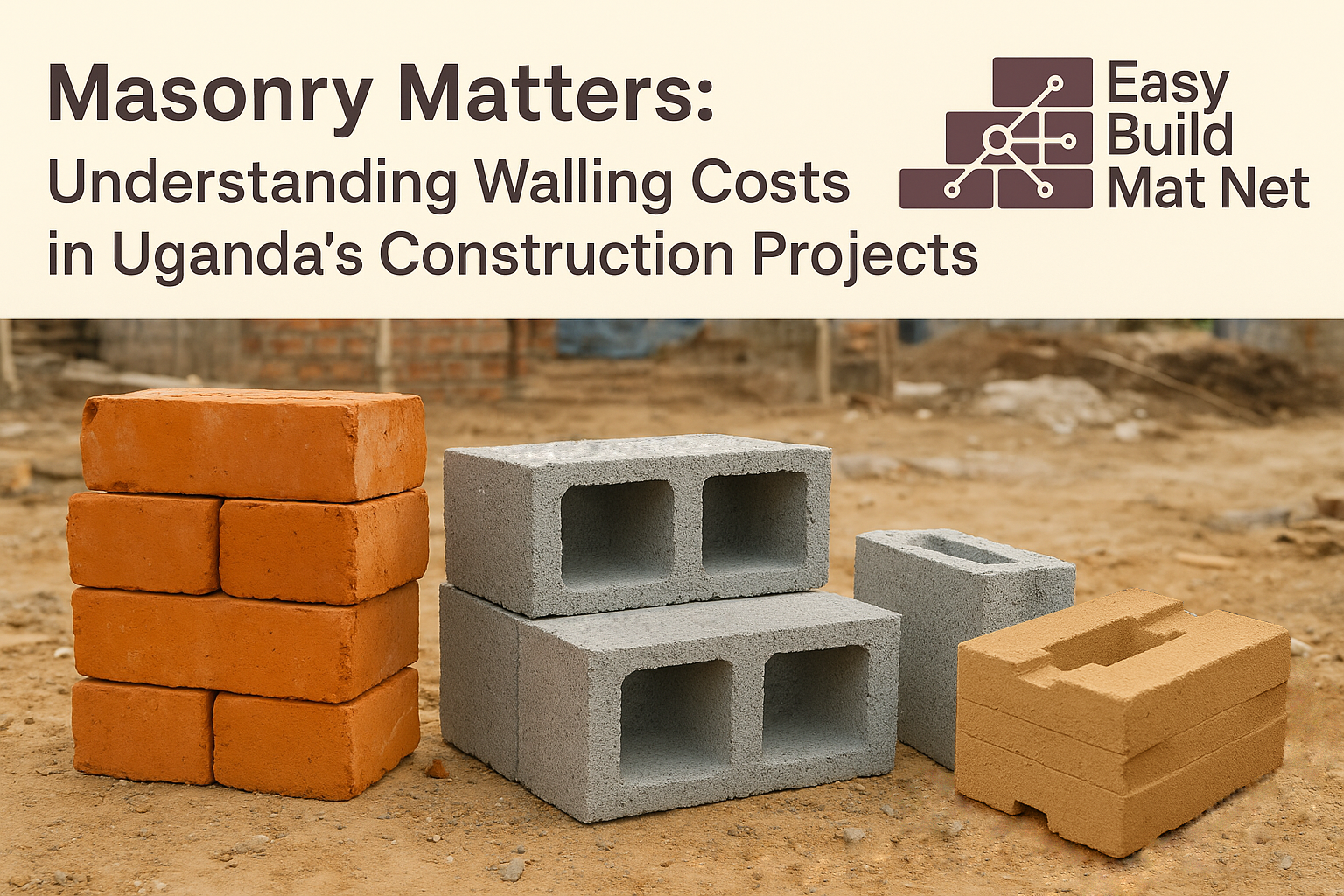
3. Common Walling Materials in Uganda
- Local burnt clay bricks: most common and widely available, but inconsistent in size and strength
- Concrete blocks (solid & hollow): uniform and fast to build with, but higher upfront cost.
- Factory-burnt clay bricks (e.g., Kajjansi, Butende): higher quality and better control, but less accessible and more expensive than local bricks.
- Stabilized Earth Blocks (SEBs, often interlocking): sustainable and good thermal performance, but limited uptake due to lack of awareness/standards.
- Stonework: increasingly used in foundations, especially in areas with high water tables. These are also popular in regions where local stone boulders are available.
4. The Costly Challenges of Masonry
Direct costs during construction:
- Extra mortar for uneven bricks
- Thicker plaster to correct poor alignment
- Weaker walls after chiseling for plumbing/electrical conduits
Indirect costs during occupancy:
- Wall dampness due to poor bricks or bad detailing
- Weak/cracking walls if blocks are low quality
- Hotter rooms & poor soundproofing from thin walls
- Higher maintenance costs
Lesson for clients: Cheap bricks often turn into expensive mistakes.
5. The Salient Reasons Walling Costs Go Wrong in Uganda
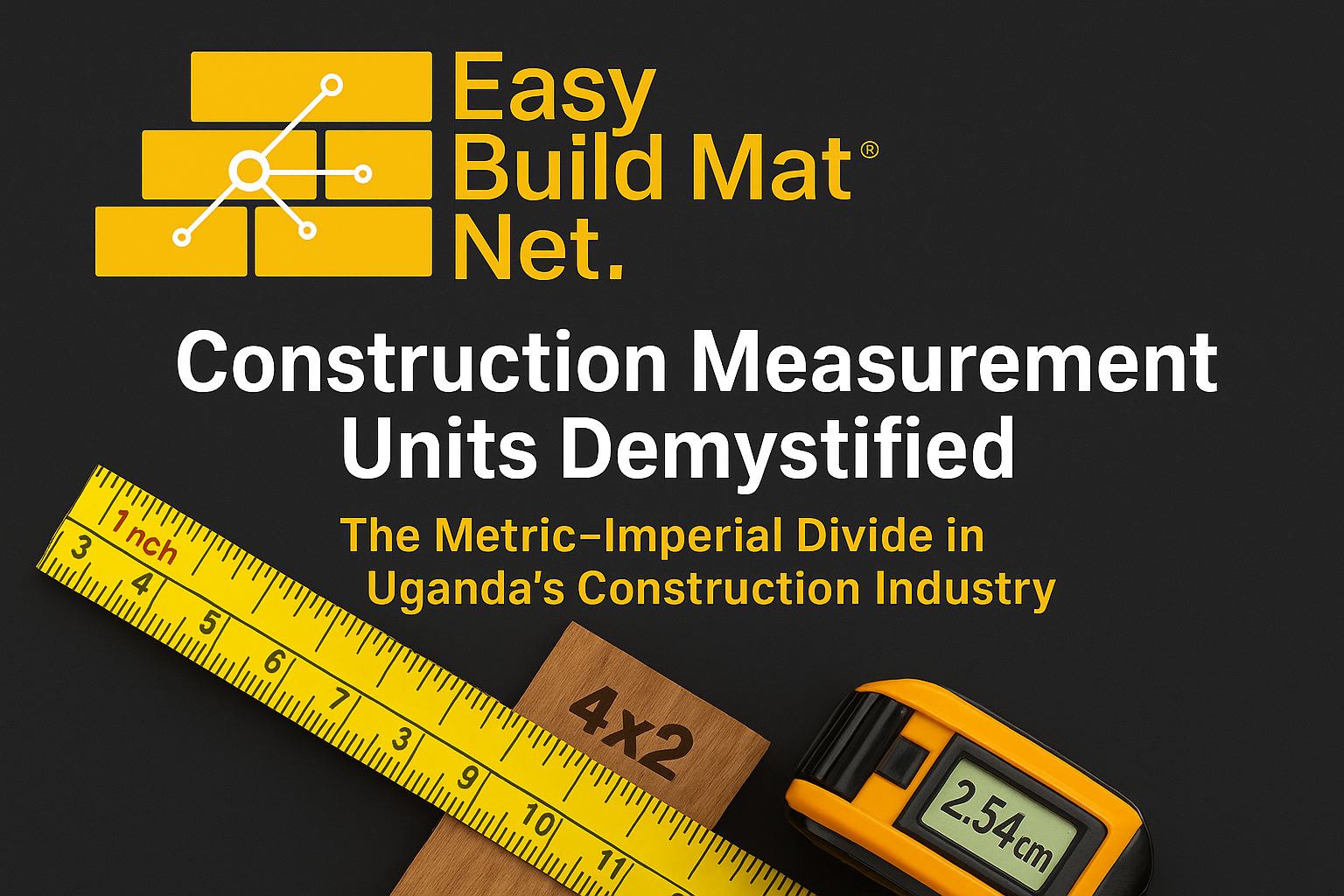
Lost in Translation: The Measurement Language Barrier
Uganda inherited the imperial system (inches, feet, yards), still used by tradesmen and clients.
Professionals, however, use the metric system (millimeters, meters) as required in design drawings.
This dual system creates confusion:
- Clients hear “50×100” plots in feet, but land titles now show meters.
- Some unqualified designers misinterpret feet as meters → house plans that don’t fit the plot.
- Clients struggle to translate between thumb-sized “inches” and precise metric numbers.
Quick comparison:
- 1 inch = 25.4 mm
- 1 foot = 305 mm (~0.3 m)
- 1 yard = 914 mm (~0.9 m)
- 1 metre = 1000 mm (~39 inches / 3.28 ft)
Bottom line: Clients and professionals are often “speaking different measurement languages.” Harmonizing these systems is key—and we’ll explore it in detail in a separate article.
The Technician Trap: Why Clients Pay More in the Long Run
Many clients prefer “technicians” (self-styled Yinginiyas) over registered professionals, thinking it’s cheaper.
Technicians often:
- Give wrong material estimates to “win” jobs.
- Source poor-quality materials to cut costs.
- Inflate quantities and pocket the difference when entrusted with purchases.
Clients only realize too late: repeated requests for “more materials,” delays, weak walls, and higher costs.
Sourcing Materials Without Verification: A Silent Cost Driver
Instead of verifying suppliers, many clients leave sourcing to tradesmen.
Result:
- Substandard bricks, weak blocks, or outright fraud
- Trucks delivering less than paid for (clients can’t verify)
- Wrong materials for the project
(Refer to our previous article on truck capacities to see why this matters—https://easybuildmat-net.com/understanding-truck-capacity-for-delivering-building-materials-in-uganda/.)
The Fallout: How These Mistakes Hit Your Project
- Cost overruns & project delays
- Poor quality, damp or weak walls
- High maintenance costs in occupancy phase
- Loss of trust between clients and professionals
6. The Big Question: How Many Bricks Do You Really Need?
Most clients ask in terms of house type— “a 3-bedroom house”—but this doesn’t directly translate into the number of bricks or blocks required. To answer this properly, we need to consider a few basics:
Step 1: Wall Thickness and Bonds
The number of bricks depends on the wall thickness in the architectural drawings. Thickness determines the bond (how bricks are laid):
- Stretcher bond: bricks laid lengthwise (commonly used in superstructure to save cost).
- Header bond: bricks laid widthwise (often used in foundations for strength).
Professionals (quantity surveyors & engineers) base estimates on these details.
Step 2: Substructure vs Superstructure
Walling happens in two main stages:
- Substructure (foundation walls): heavier, stronger, usually header bond.
- Superstructure (above ground): a mix of header and stretcher bonds for economy.
Step 3: Quick Benchmark Guide (Using Bricks)
For a typical residential house:
- Foundation walls: ~50–60 bricks per m² of floor area
- Superstructure walls: ~70–80 bricks per m² of floor area
This is a fast estimating method for clients familiar with “bedrooms” rather than technical wall area measurement.
(Note: deeper foundations or higher ceilings increase this.)
Typical House Rough Estimates
- 3-bedroom house (120–150m² floor area): ~15,000–18,000 bricks
- 4-bedroom house (180m² floor area): ~20,000–24,000 bricks
This helps clients move from vague assumptions to realistic planning.
Step 4: Professional Method
Quantity Surveyors and Engineers calculate more precisely by:
- Measuring the actual wall area (foundation + superstructure) from the drawings.
- Applying coverage rates:
- Stretcher bond: 35–40 bricks per m²
- Header bond: 60–65 bricks per m²
- Blocks: 10–11 per m²
- Adjusting for mortar joints, wall thickness, wastage
Step 5: Bricks vs Blocks
- Bricks: still dominant in Uganda, especially for foundations.
- Blocks: increasingly used in urban projects for speed and uniformity, though less common in foundations.
Research has shown that blocks can also perform well in substructure, but cultural preference still favors bricks.
✅ Takeaway for Clients
Walling requirements depend on:
- Your house size (floor area)
- The wall thickness and bonds in your design
- Whether you’re using bricks, blocks, or a mix
Understanding these basics helps avoid underestimating walling costs and ensures smoother project planning.
7. The Solution: Smarter Choices & Better Access
Clients and professionals need clear, reliable information—and access to verified suppliers.
That’s where Easy BuildMat-Net (EBMN) comes in:
- Locate reliable hardware & material suppliers near your project
- View verified prices for bricks, blocks, mortar inputs
- Get real-time delivery quotes from trusted drivers
- Secure payments & transparent transactions
- Access insights & guides (like this article) to support better planning
With EBMN, clients avoid guesswork—and professionals gain a trusted tool to advise accurately.
8. Conclusion: Making Masonry Smarter
Walling is not just about buying bricks or blocks. It is:
- A major cost driver in shell & core (25–30%)
- A quality benchmark affecting strength, comfort, durability
- A long-term investment that influences maintenance and resale value
By understanding the true costs and choices in walling, clients can avoid surprises and build smarter.
At Easy BuildMat-Net, we are bridging the gap—connecting you to quality walling suppliers, verified prices, and reliable delivery.
Masonry made smarter, faster, and more cost-effective.
Visit EBMN and connect to verified suppliers today.
This Article was authored by Francis Nsubuga (Assistant Quantity Surveyor at Gridway Engineering Services Ltd), with review and additional input from Antony Ainobushoborozi


 No products in the cart.
This is a very insightful article, especially for non-professionals, precise and educational! thanks, Mr Nsubuga
Glad you find the article Mr.Jonathan , and I can assure you that there’s more in store that we are yet to publish.