
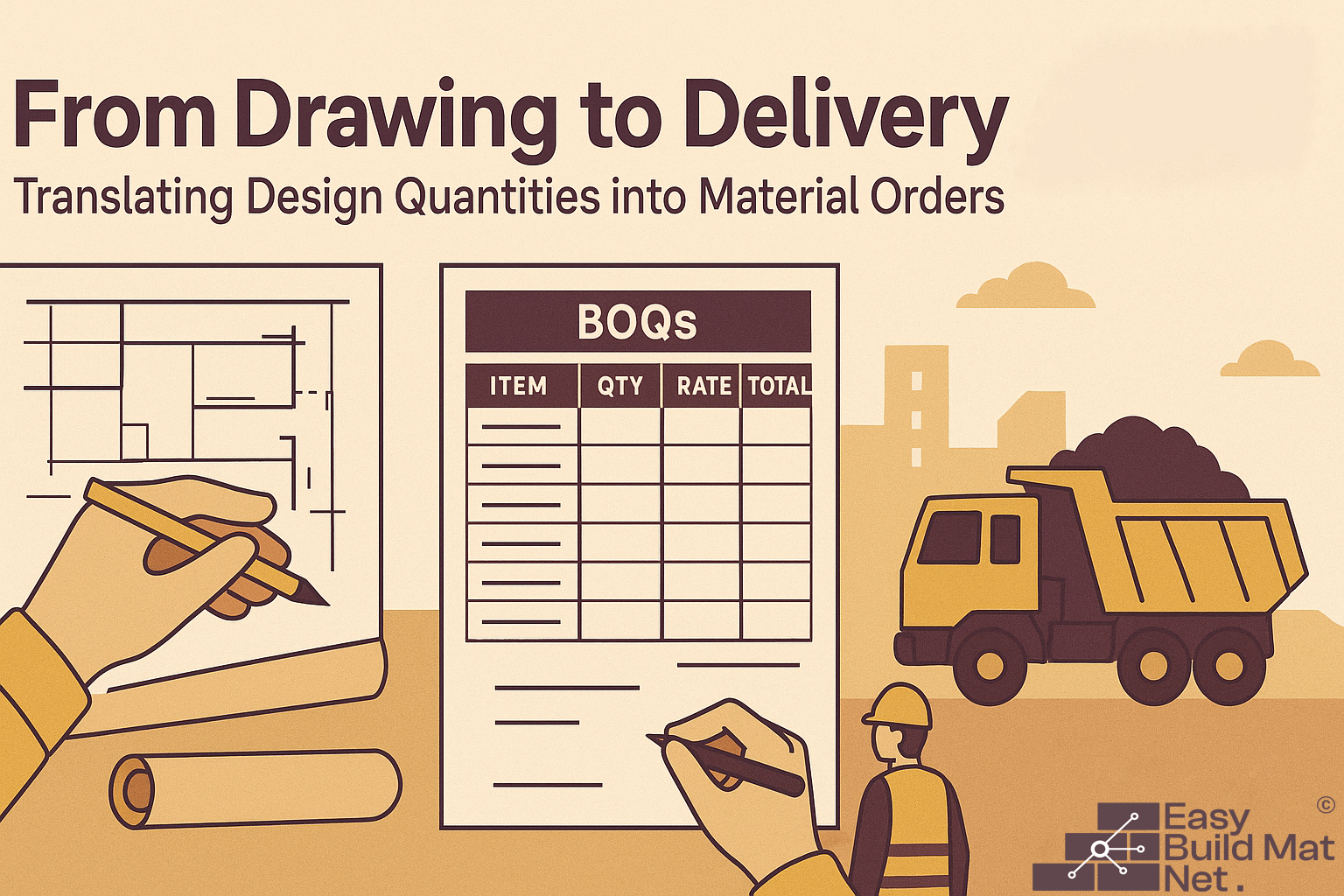
Educating Clients on the Journey from Design to Construction Execution
1. Introduction: Why Understanding the Full Process Matters
Every building starts as an idea then gets conceptualized into a drawing, but the real success of construction lies in how accurately those designs are interpreted, quantified, and delivered on-site.
In Uganda, many private developments — especially self-funded residential projects — face cost overruns, material shortages, and rework due to one common cause: a broken link between design, procurement, and delivery.
Clients often receive approved drawings and assume construction can proceed directly with the help of a technician or foreman. But in doing so, they unknowingly skip key professional roles and quality controls mandated by the Building Control Regulations (2020) — leading to financial loss, poor workmanship, and unsafe structures.
This article explores these challenges and shares practical insights for clients, developers, and professionals seeking to bridge the gap between design and delivery.
2. The Everyday Reality: Where Construction Goes Wrong
Uganda’s construction environment is vibrant but faces recurring pitfalls — especially at the small residential level, where private clients often double as project managers.
Without professional oversight, even simple projects spiral into waste, rework, or cost overruns.
Understanding the Real Challenge
Every private construction project begins with a drawing — yet very few clients can translate those lines and dimensions into actual quantities of materials.
For many, the biggest gap lies between what is drawn and what is ordered.
When technicians provide quotations, most clients take them as truth. Yet behind those neat figures, there are often no measurements, no verification, and no clear basis.
Clients only reach out to professionals when something “feels off” — usually after materials are already ordered or finished mid-way.
This disconnect explains why many projects start with optimism and end in financial fatigue — where costs keep rising, and no one can clearly explain why.
2.1. Real Scenarios Clients Commonly Face
(a) The Walling Dilemma
A client receives approved drawings and asks a technician for a material estimate.
“You’ll need about 30,000 bricks and 80 bags of cement,” he says.
Halfway through, materials run out and costly top-ups begin.
What went wrong:
No one measured wall areas or converted them to actual brick counts. A Quantity Surveyor (QS) would have calculated wall length × height – openings × wall thickness, then used standard brick coverage conversions based on the designed wall thickness and bond to determine exactly how many bricks were needed for that wall section.
(b) The Concrete Ground Floor Slab Problem
A technician quotes:
“30 bags of cement, 3 trips of sand, and 2 trips of aggregate.”
The client agrees. But midway, materials are finished — yet the slab isn’t. More top-ups follow.
What went wrong:
The slab area and thickness were guessed, not measured. A Quantity Surveyor (QS) would have calculated: 120 m² × 0.15 m = 18 m³ of concrete, then applied standard mix ratios to determine the exact quantities of cement, sand, and aggregate required.
In addition, the technician omitted the BRC mesh reinforcement specified in the structural drawings — assuming it was unnecessary because it had been skipped on previous small projects.
However, for this particular structure, the mesh was a critical load-bearing and crack-control requirement, and its omission compromised both strength and compliance.
What looks like a “small shortcut” in estimating materials can have major structural and financial consequences. Design intent should never be replaced by assumption.
These examples may sound simple but reveal a single truth:
Without measurement and translation, construction becomes guesswork.
2.2. Common Consequences
- Wrong material orders (e.g., lake sand for plaster).
- Under- or over-ordering, causing delays, wastage, and inflated transport costs.
- Structural defects due to deviation from approved drawings.
- Cost overruns from poor tracking, theft, and unverified deliveries.
- Loss of trust between clients and professionals.
Until clients treat design and cost professionals as part of a continuous process — from drawing to delivery — these costly patterns will persist.
3. Uganda’s Construction Landscape: Why Small Projects Suffer Most
The construction sector contributes roughly 12% of Uganda’s GDP and supports hundreds of thousands of jobs.
According to UN-Habitat (2023) and Trade.gov (2024), Uganda faces a housing deficit of about 2.4 million units and requires 300,000 new homes annually to meet growing demand.
Sector Breakdown
- Large-scale projects (10%) – Government or corporate developments with full professional supervision.
- Medium-scale projects (20%) – Real estate, institutional, and apartment developments with partial supervision.
- Small residential projects (70%) – Privately funded homes, often built informally without technical oversight.
While large and medium projects rely on teams of registered professionals and strict quality assurance — because the capital at stake is too great to risk — most small-scale clients see these steps as optional.
It’s within this 70% private residential category that most inefficiencies occur — informal management, limited documentation, poor procurement tracking, and reliance on unqualified “technicians” leading to substantial losses.
To them, every extra fee feels avoidable, yet the accumulated losses from guesswork, rework, and waste often exceed professional fees many times over.
In short, what seems small in scale is big in impact — and entirely preventable.
4. What the Building Control Regulations (2020) Actually Require
Part III — Control of Building Operations sets out the legal framework for professional engagement in all building activities.
Under Regulation 5, every owner of a building (other than a minor building –not more than 30 square meters in floor area) must:
(a) Employ an Architect for architectural design.
(b) Employ an Engineer for structural and services design.
(c) Employ a Surveyor for boundary and land surveying.
(d) Retain the Architect and Engineer for supervision until completion.
(e) Retain a Health and Safety Expert on site.
(f) Engage any other professional necessary for the building operation.
However, Cost Estimates or Bills of Quantities (BOQs) are not explicitly listed among the mandatory documents for submission or approval — leaving the crucial role of the Quantity Surveyor (QS) largely unrecognized.
This omission has had far-reaching implications. In practice, most private developers are unaware that cost management, procurement planning, and material tracking are professional services — not tasks for artisans or site technicians.
Consequently, many projects suffer from uncontrolled spending, inconsistent quality, and loss of accountability once construction begins.
This regulatory gap, coupled with weak enforcement by Building Committees, means that while design supervision by architects and engineers is mandated, financial supervision and material control — the QS’s domain — is left to chance.
By the time clients realize the importance of cost planning, they have already over-ordered, under-budgeted, or substituted materials that compromise quality.
Regional Perspective: How Other Countries Handle It
To place Uganda’s framework in context, it helps to examine how neighbouring countries address the Quantity Surveyor’s role.
Regional Comparison — Learning from East Africa
Rwanda: The Rwanda Building Control Regulations and related submission guidelines require that a Bill of Quantities (BOQ) accompany architectural and structural drawings when applying for a building permit. This embeds cost documentation into the approval process, ensuring accountability before construction begins.
Kenya: The Architects and Quantity Surveyors Act (Cap 525) and its By-laws explicitly recognize Quantity Surveyors as licensed professionals responsible for preparing BOQs, cost estimates, and contract documentation. No major public or private development proceeds without QS certification of cost documents.
Tanzania: Under the Architects and Quantity Surveyors Act, 2010 and related practice regulations, QSs are mandated participants in both design and construction phases, ensuring cost control, value for money, and proper payment certification.
These examples highlight a regional consensus — that financial and cost management oversight is as essential as architectural or structural design.
Mandating QS involvement promotes transparency, minimizes waste, and safeguards clients’ investments.
Ultimately, the QS serves as the financial conscience of the project— ensuring that every brick, bag of cement, or steel bar has a measured, verified, and justified place within the construction process.
Integrating this role within the regulatory framework would close the long-standing cost management gap that continues to burden Uganda’s private construction sector.
5. The Right Process: Turning Drawings into Material Orders
Beyond design approval, the true success of any project depends on how drawings are translated into measurable, purchasable, and verifiable quantities.
5.1. Step 1: Design Stage – The Starting Point
- Drawings define sizes, layout, and units (mm or m).
- Clients should request a walk-through from their Architect/Engineer to understand every dimension.
5.2 Step 2: Quantification Stage – The Measurement Bridge
- The Quantity Surveyor measures all building components using the Standard Method of Measurement (SMM).
- Outputs include a Bill of Quantities (BOQ) or Material and Labour Schedule, itemizing materials per trade.
- This is where the “translation” happens — turning drawn dimensions into practical numbers (e.g., 1,000 blocks, 50 bags of cement, 8 tonnes of steel).
5.3 Step 3: Verification Stage – Client Understanding
- The client and QS should review the BOQ line by line.
- Ask: “Is this M&L split into phases? How do I know how much cement I need for the foundation alone? Is wastage allowed for?”
- This step ensures clarity before orders are placed.
5.4 Step 4: Procurement Stage – Converting to Market Language
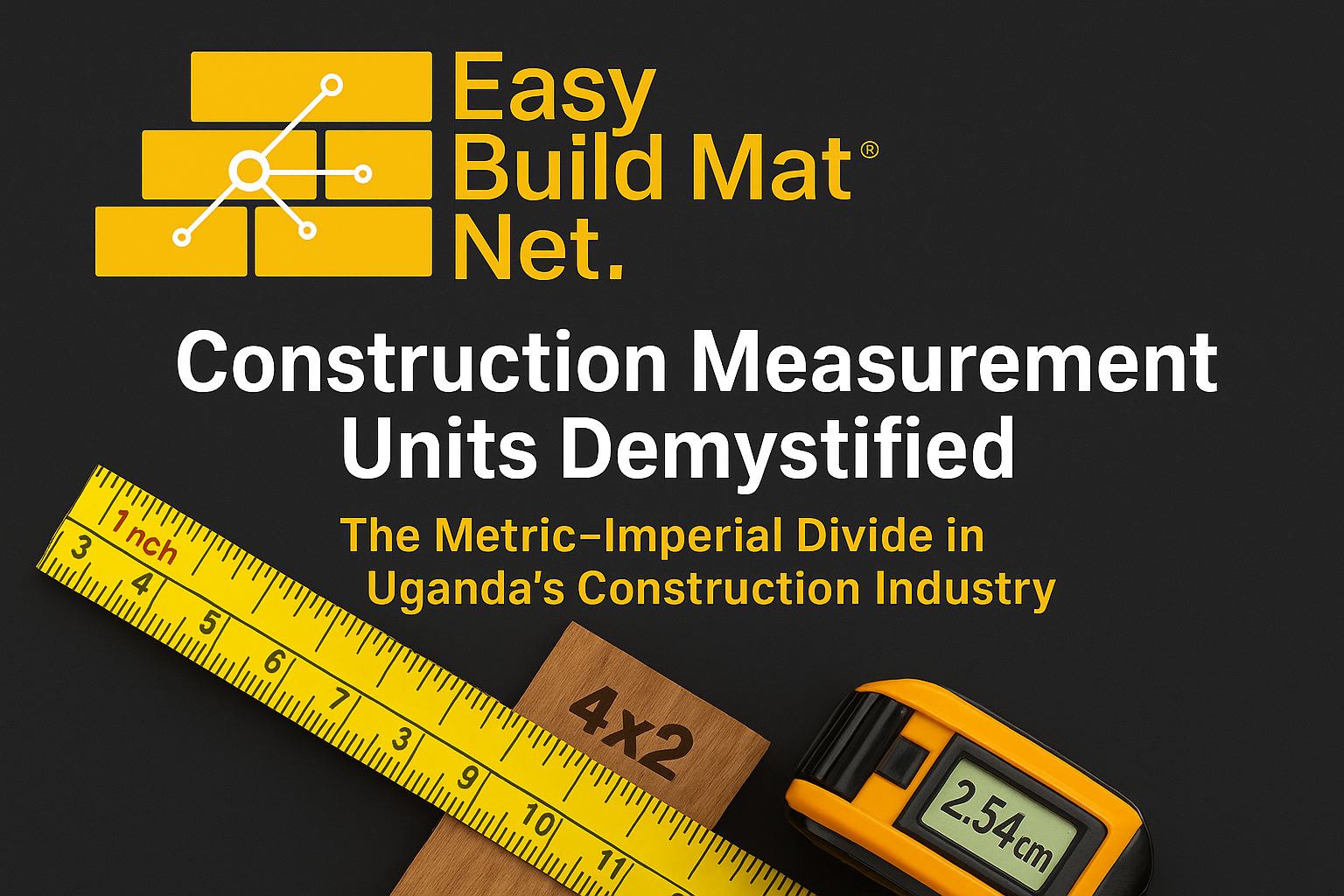
- Suppliers sell in trade sizes and imperial units (inches, feet).
- The QS or procurement agent should cross-check conversions:
- 200 mm wall = 8-inch block wall
- Concrete C25 = what mix ratio of cement: sand: aggregate=specific materials per total volume of concrete required for the slab
- 100 × 50 mm timber = 4 × 2 inches
- Quotations should indicate both units to avoid misinterpretation.
5.5 Step 5: Ordering Stage – Controlled Procurement
- Clients should not buy everything upfront.
- Materials like cement, sand, and aggregates are best bought per phase to reduce waste.
- Verify deliveries — ensure what’s received matches the order quantity and specification.
5.6 Step 6: Execution Stage – Site Supervision and Tracking
- The BOQ or Material schedule is not just a pricing document — it’s a live control tool.
- It helps track progress, material consumption, and expenditure.
- Professionals (architect, engineer, QS) should periodically visit site to verify that materials are used as planned.
5.7. Step 7: Post-Completion Stage – Reconciliation
- After project completion, a final account compares estimated vs. actual quantities.
- This helps clients understand where variations occurred and improves future planning accuracy.
5.8. Key Message for Clients
Construction success depends on translation — not assumption. Every material on site should trace back to a line on the drawing and a quantity on the BOQ. When this link is broken, the project loses control, and the client pays the price.
Ask questions. Seek explanations. Involve professionals early. The goal is not to make construction expensive — it’s to make it predictable, efficient, and transparent.
6. The Professional Roadmap: Who Does What and Why It Matters
| Professional/Stakeholder | Key Roles & Responsibilities | Why It Matters to You (Client) |
| Architect | Designs building layout, form, and function; ensures compliance with planning and approval standards. | Translates your vision into a functional and approved design. |
| Structural/Services Engineer | Designs structural integrity and building services (electricity, plumbing, drainage). | Guarantees safety, durability, and performance of your building; mistakes here are costly to fix later. |
| Quantity Surveyor (QS) | Prepares cost estimates, Bills of Quantities, and procurement schedules; manages cost control and value for money. | Ensures you buy the right materials, in the right quantities, at the right cost. Prevents waste and overruns. |
| Land/Building Surveyor | Verifies plot boundaries and provides topographic and setting-out data. | Prevents land boundary disputes and construction outside legal limits. |
| Health & Safety Expert | Oversees safe working practices and environmental standards. | Reduces risk of site accidents and liability. |
| Contractor/Technician/Artisan | Executes construction under professional supervision. | Implements—not designs—the approved plans and specifications. |
| Material Supplier | Provides materials meeting required standards and specifications. | Cheap or Substandard materials cause hidden costs later; always buy from verified suppliers. |
7. The Client’s Quality Assurance Checklist
Clients play the central role in driving quality and accountability. Here’s your Quality Assurance Checklist for every stage of construction:
(a) Before Construction
- Engage the right professionals — not just the cheapest option.
- Verify registrations — ensure your Architect, Engineer, and QS are registered with their respective professional bodies (ERB, ARB, SRB)
- Request for a BOQ or a Material & Labor Schedule — not just as a price list, but as a usable live document for monitoring costs and materials.
(b) During Construction
- Retain your supervising professionals as per regulations.
- Use the BOQ/ M&L schedule to verify the contractors material requisitions before placing material orders as well as their labor quotations per stage
- Cross-check supplier quotations against the BOQ and delivery notes.
- Avoid verbal instructions — document all changes.
(c) Procurement and Material Control
- Source materials from verified suppliers.
- Confirm truck capacities and delivery volumes (see our earlier article on truck capacities).
- Maintain a material register and reconcile deliveries against site usage
8. The Smart Solution: How Easy BuildMat-Net Bridges the Gap
Throughout this article, we’ve seen how most construction challenges — from underestimating materials and poor procurement planning to miscommunication between professionals and clients — stem from one fundamental issue: the lack of a structured link between design, cost, and delivery.
That’s where Easy BuildMat-Net (EBMN) comes in.
EBMN isn’t just another construction platform — it’s a digital bridge that connects the dots between drawings, cost estimates, materials, and delivery. It transforms what is usually a fragmented process into a transparent, data-driven, and verifiable workflow that clients and professionals can both trust.
Easy BuildMat-Net (EBMN) empowers both professionals and clients to bridge this long-standing gap between design, cost and delivery through;
- Access to verified hardware stores and material suppliers — ensuring you buy the right materials at the right prices.
- Up-to-date market prices for construction materials to help in budgeting and cost control.
- Real-time logistics quotes from trusted drivers for predictable delivery planning.
- Secure transactions and transparent tracking, reducing fraud and material losses.
- Educational resources like this Construction Insights Series — designed to promote informed decision-making for clients and professionals alike.EBMN empowers clients to plan better, professionals to advise more accurately, and suppliers to serve transparently — creating a more efficient construction ecosystem.
9. Conclusion: Seek Guidance, Build with Confidence
A well-designed project is only as good as its delivery.
Whether it’s foundation, walling, or roofing — each stage begins with accurate understanding of design quantities and costs.
Clients who seek early professional guidance from Architects, Engineers, and Quantity Surveyors minimize waste, avoid fraud, and achieve true value for money.
Construction isn’t guesswork — it’s a coordinated process blending design, cost, and delivery.
When clients understand each stakeholder’s role and ask the right questions early, every project becomes smarter, safer, and more affordable.
Easy BuildMat-Net — bridging the gap between design, cost, and delivery.
References
- The Building Control Regulations, 2020. Statutory Instrument No. 36 of 2020, Ministry of Works & Transport.
- UN-Habitat (2023). Uganda Housing Profile. UN-Habitat.
- Trade.gov (2024). Uganda Country Commercial Guide: Construction Sector Overview. U.S. Dept of Commerce.
- UBOS (2023). Annual Construction Sector Performance Report. Kampala.
- Easy BuildMat-Net (2025). Construction Insights Series — Understanding Truck Capacities & Masonry Matters.
This Article was authored by Nsubuga Francis (Assistant Quantity Surveyor, Gridway Engineering Services Ltd) , with review and additional input by R.S.U Ainobushoborozi Antony.


 No products in the cart.
This is a very nice piece. Thank you Francis and Antony
Most appreciated Annette
That’s the most critical part when it comes to procurement dealing with works. Ability to interpret BOQ’s vs Budget vs Actual expenditure and market survey https://s.w.org/images/core/emoji/16.0.1/svg/1f44c.svg is so critical. So much money goes in ignoring these areas.
David Kweezi Mwebesa (Bisou) – Procurement Specialist