
- Why Measurement Systems Matter in Construction
Measurement systems form the backbone of accuracy, cost control, and coordination in construction. They determine how drawings are interpreted, how materials are ordered, and how work is executed on-site.
In Uganda, confusion often arises from the coexistence of the metric and imperial systems — a historical legacy that continues to affect design documentation, procurement, and site practice. A small error in converting or interpreting units can lead to significant cost overruns, material waste, or dimensional inconsistencies.
For instance, while Bills of Quantities (BoQs) typically express timber and formwork in metres or square metres, suppliers sell materials in imperial sizes such as 4×2 inch × 12 feet or 6×2 inch × 10 feet. Without careful conversion, discrepancies arise between specified quantities and procured materials. Similarly, land and plot measurements are often referred to in feet (e.g., 50×100 ft plots) even though titles record dimensions in metres and total area in hectares — creating inconsistencies in surveying and documentation.
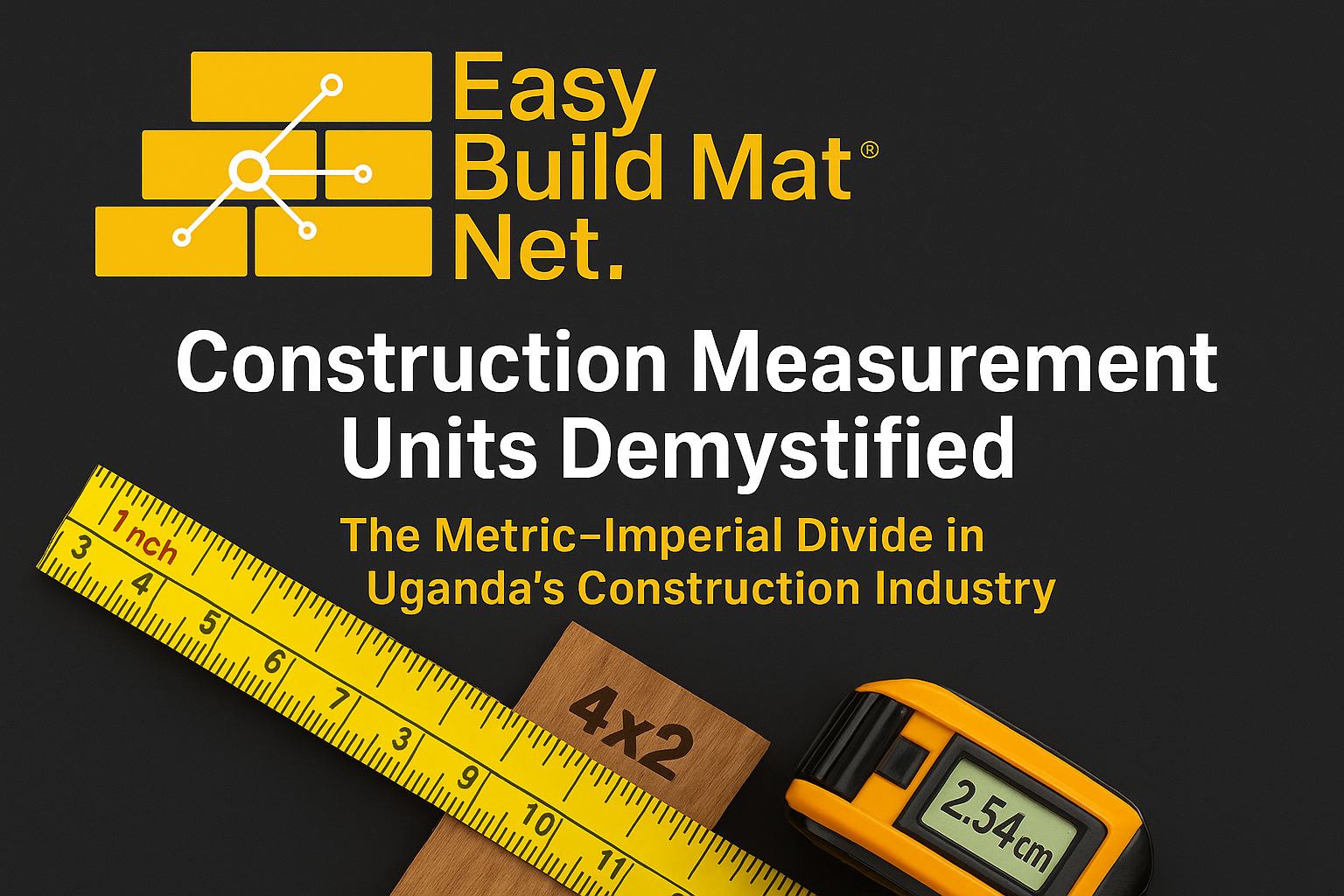
Even measuring tools reflect this duality: most tape measures and digital devices display both metric and imperial scales. While this provides flexibility, it also increases the risk of misinterpretation during setting out, measurement, and valuation.
These examples illustrate why a clear understanding of both measurement systems is essential. In a construction industry where drawings, specifications, and materials still reference both systems, professionals must navigate the metric–imperial divide with precision and consistency to ensure accuracy, efficiency, and value in project delivery.
2. Understanding the Two Systems in Uganda
The imperial system — which uses inches, feet, and yards — was widely used in Uganda before the country officially adopted the metric system in the 1970s. However, it remains common today among older professionals, in imported materials, and in renovation works involving colonial-era buildings.
Under the Weights and Measures Act (Cap 84), Uganda legally recognizes both systems:
The metric system, based on the metre and kilogram, and
The derived (imperial) system, based on the yard and pound.
The Act establishes the yard and the metre as the reference units of length, defining one yard as exactly 0.9144 metres. It also empowers the Minister to prohibit the use of the imperial system in specific industries or trades by statutory order, effectively positioning the metric system as the national standard but imperial units continue to appear in construction procurement, imported materials, and site-level communication. In the construction industry, this coexistence is evident in:
- Drawings and BoQs prepared in metric units,
- Imported materials labelled in imperial units, and
- Site artisan teams often referencing dimensions in feet and inches.
Understanding both systems — and how they interrelate — is therefore crucial for quantity surveyors, contractors, and site engineers.
2.1 The Metric System
Uganda officially uses the metric system, which is based on multiples of ten. This simplicity makes conversions easy and calculations straightforward. It is the standard for design, documentation, and most construction measurements.
Common Units Used in Construction
- Metre (m): Fundamental unit of length for building dimensions, wall lengths, and site layouts.
- Centimetre (cm): Used for smaller components and interior fittings.
- Millimetre (mm): Common in detailed design, fittings, and tolerances.
- Square metre (m²): Used for areas such as plastering, painting, and flooring.
- Cubic metre (m³): Used for volumes like concrete, soil, and backfill.
- Hectare (ha): Used for land area measurement (1 hectare = 10,000 m²).
How the Metric System Works
- 1 metre (m) = 100 centimetres (cm)
- 1 centimetre (cm) = 10 millimetres (mm)
- 1 metre (m) = 1,000 millimetres (mm)
- 1 kilometre (km) = 1,000 metres (m)
Advantages of the Metric System
- Simple conversions (powers of ten).
- Greater precision and standardization.
- Universally adopted across engineering and design disciplines.
- Consistent with Uganda’s technical education and regulatory standards.
The metric system dominates architectural, structural, and MEP drawings, as well as Bills of Quantities, specifications, and material schedules across Uganda. It is also the reference system in the Weights and Measures Act (Cap 84) and upheld by the Uganda National Bureau of Standards (UNBS).
2.2 The Imperial System
The imperial system was introduced into what is now Uganda during the British colonial period (from the late 19th century). Through land surveys, infrastructure construction, education, and trade under British administration, units such as feet, inches, and yards became embedded in construction practice and trading culture. Over decades, they became part of the everyday building trade and grassroots practice, explaining why even today imperial unit references persist in local material supply chains, tool-use and verbal instructions.
Common Units Still in Use
- Inch (in): For pipes, fittings, joinery, and finishes.
- Foot (ft): The basic unit for vertical and horizontal dimensions on-site.
- Yard (yd): For larger linear or area measurements (1 yd = 3 ft).
- Square foot (ft²): For floor, wall, and plot areas.
- Cubic foot (ft³): For timber or small volume materials.
- Acre: For land and property measurements (1 acre = 4,840 square yards).
- Decimal: Equivalent to 1/100 of an acre, commonly used in property markets to describe land area (e.g., 12 decimals = 0.12 acre).
How the Imperial System Works
- 1 foot = 12 inches
- 1 yard = 3 feet = 36 inches
- 1 mile = 5,280 feet
- 1 square yard = 9 square feet
- 1 cubic yard = 27 cubic feet
- 1 acre = 43,560 square feet
Advantages of the Imperial System
Despite its complexity, the imperial system offers several practical benefits, especially in Uganda’s construction environment:
- Familiarity Among Craftsmen and Older Practitioners:
Many artisans, foremen, and hardware suppliers continue to use imperial dimensions due to long-established practice and historical training.
- Common in Material References:
Several construction materials — such as timber, pipes, and certain fittings — are still described in imperial units in suppliers’ catalogs, e.g., 4×2 inch timber or 1-inch pipe.
This makes it easier for site personnel to visualize and interpret materials during procurement and installation.
- Practical for On-Site Interpretation Due to Body-Based Proportions:
One enduring advantage of the imperial system is its origin in human body proportions, which makes it highly practical for quick, on-site estimation.
- Inch (1”) – roughly the width of an adult thumb at the base of the nail.
- Foot (12”) – approximately the length of an average adult foot or shoe.
- Yard (3 ft) – close to the distance from the tip of the nose to the end of an outstretched arm.
These intuitive body-based references enable workers to estimate lengths or sizes when a measuring tool is not immediately available — a feature that has kept the imperial system alive on Ugandan construction sites for decades.
- Allows Fractional Measurements:
Inches are often divided into fractions (e.g., ½”, ¼”, ⅛”), which simplifies manual adjustments and fitting tasks in carpentry and plumbing.
While less standardized globally, the imperial system remains deeply rooted in Uganda’s site practice, particularly among artisans and hardware suppliers, due to its familiarity and practicality in everyday construction work.
2.3 Coexistence and Practical Implications
Uganda’s construction industry operates in a dual-measurement environment.
Drawings and BoQs are prepared in metric units, yet site operations, supplier quotations, and land transactions often rely on imperial measurements.
Understanding the two systems — their structure, conversion, and application contexts — enables practitioners to:
- Translate quantities accurately between documents and on-site requirements.
- Avoid errors when ordering or cutting materials measured in imperial units.
- Communicate effectively with craftsmen, suppliers, and clients.
- Maintain consistency with the national legal framework (Cap 84) and UNBS standards.
3. Why the Confusion Persists
Despite metrication being the national standard, Uganda’s construction environment continues to operate within a mixed-unit reality. The confusion stems from several overlapping factors:
- Historical Legacy: Older building codes, technical staff, and craftsmen were trained using imperial units, which continue to influence daily site practice.
- Material Supply Chains: In Uganda, timber, plumbing pipework, and finishing materials are often described in imperial units, even though drawings use metric specifications. For instance, a 25 mm PPR pipe is commonly referred to as a 1-inch pipe, and timber as 4×2 inches. Such inconsistencies between design documents and supplier references often confuse contractors and clients during procurement.
- Land and Property Measurements: Plot sizes are commonly described in feet (e.g., 100×50 ft) in the property market, while official land titles express the same parcels in metres and total areas in hectares — a metric unit equal to 10,000 square metres. At the same time, valuation reports frequently use acres, an imperial unit, leading to inconsistencies.
- Tools and Equipment: Measuring tapes and digital distance meters typically feature both scales, requiring users to double-check which unit is being applied during setting out or quantification.
This overlap can easily result in conversion errors, dimensional mismatches, and cost discrepancies unless properly managed.
4. Legal and Standards Framework in Uganda
The Weights and Measures Act (Cap 84) establishes Uganda’s legal framework for measurement. It defines both metric and imperial (derived) units, setting the metre as the principal reference for length and the kilogram for weight.
The Act also provides official equivalences between the two systems, ensuring consistency across measurement practices. For instance:
- 1 yard = 0.9144 metres
- 1 foot = 0.3048 metres
- 1 inch = 25.4 millimetres
Part VIII of the Act further empowers the Minister of Trade to restrict or prohibit the use of the imperial (derived) system in specified trades or industries. This means Uganda’s transition to the metric system is legally supported but practically gradual, depending on enforcement and awareness across sectors.
Complementing this, the Uganda National Bureau of Standards (UNBS) — established under the UNBS Act (1983) — plays a central role in standardization, calibration, and verification of measuring instruments. UNBS upholds the metric system as the reference for trade, industry, and construction, ensuring that all official measurements conform to international metric standards.
5. Conversions and Equivalences in Construction
The Weights and Measures Act (Cap 84) provides a structured relationship between metric and imperial units. The following tables highlight common conversions used in construction:
Length Conversions
| Imperial Unit | Metric Equivalent |
| 1 inch | 25.4 millimetres |
| 1 foot | 0.3048 metres |
| 1 yard | 0.9144 metres |
| 1 mile | 1,609 metres |
Area Conversions
| Imperial/Metric Unit | Equivalent |
| 1 square foot | 0.0929 square metres |
| 1 square yard | 0.836 square metres |
| 1 acre | 4,047 square metres |
| 1 hectare (metric) | 10,000 square metres |
Note: The hectare is a metric unit, while the acre belongs to the imperial system. Both are still widely used in Uganda’s land and property markets, leading to frequent interchange and misunderstanding.
6. Demystifying the Metric–Imperial Divide
Bridging the gap between metric and imperial measurement systems requires a shift in both awareness and practice. A clear grasp of both systems — and their legal basis under Uganda’s Weights and Measures Act (Cap 84) — not only improves technical accuracy but also enhances cost control, quality assurance, and communication across all stakeholders in Uganda’s construction industry.
To minimize confusion, errors, and inefficiencies, the following best practices are recommended:
- Always Check the Unit
Never assume. Confirm whether a figure such as “150” refers to mm, cm, or inches.
A missing or unclear unit symbol is a common cause of site measurement disputes and procurement errors.
- Standardize Documentation
All drawings, Bills of Quantities, and site instructions should clearly indicate the system used, for example:
“All dimensions are in millimeters unless otherwise stated.”
Where imperial dimensions are unavoidable, include the metric equivalent for clarity:
e.g. 9” (230 mm) wall thickness.
Consistent notation ensures everyone — from designer to site foreman — interprets measurements uniformly.
- Keep Conversion References Handy
Maintain a reliable conversion chart in every site office or consultant’s workstation.
Basing conversions on the Weights and Measures Act ensures accuracy and uniformity.
Quick Field Tips:
- Feet → Meters: divide by 3
- Inches → Centimeters: multiply by 2.5
- Meters → Feet: multiply by 3.3
- Square Feet → Square Meters: divide by 10
- Cubic Feet → Cubic Meters: divide by 35
- Acres → Hectares: divide by 2.47
- Hectares → Acres: multiply by 2.47
- Decimals → Acres: multiply by 0.01 (1 decimal = 1/100 acre)
These approximations are practical for quick checks, while detailed calculations should use verified tables or digital tools.
- Engage Suppliers Carefully
When receiving quotations or specifications, request that both unit systems be indicated to avoid ambiguity:
- “2-inch pipe (50 mm nominal diameter)”
- “6 × 1 inch timber (150 × 25 mm)”
This maintains alignment between design specifications, procurement documents, and on-site implementation.
- Sensitize and Train Site Teams
Provide regular training for foremen, artisans, and procurement officers to improve understanding of measurement equivalences and their implications on cost and quality.
At pre-start meetings, agree on one working system and ensure all measurements, levels, and records follow it consistently.
- Use Conversion Tools Wisely
Digital calculators, mobile apps, and online converters simplify work but can introduce rounding errors. Always cross-check key figures against trusted references, especially for concrete volumes, finishes, or cost-sensitive elements.
- Engage Quantity Surveyors Early
Quantity Surveyors are best placed to interpret, verify, and reconcile measurement units across design, procurement, and execution.
Their involvement ensures consistency, mitigates disputes, and upholds compliance with recognized measurement standards.
- Encourage Knowledge Sharing
Foster collaboration between senior practitioners accustomed to the imperial system and younger professionals trained in metric practice.
This inter-generational exchange promotes understanding, accuracy, and professional growth across the industry.
7. Conclusion
The confusion between the metric and imperial systems in Uganda is not a sign of incompetence — it is a legacy of history.
By cultivating awareness, improving documentation clarity, and fostering collaboration across generations of professionals, Uganda’s construction industry can overcome this persistent challenge.
Clarity in measurement language is the first step toward accuracy, efficiency, and professionalism in every project.
References
- Government of Uganda. Weights and Measures Act, Cap 84 (Revised Edition).
- Uganda National Bureau of Standards Act (1983).
- Uganda National Bureau of Standards (UNBS): Official website and measurement verification guidelines.
The Article was authored by RSU Antony Ainobushoborozi , with editorial assistance by Nsubuga Francis (Assistant Quantity Surveyor at Gridway Engineering Services Ltd)



 No products in the cart.
I didn’t know of the weights and measure Act Cap 84. Now grounded on what underpins the use of the metric system in Uganda. Thank you.