

How Tyre count relates to tonnage & value for money

Efficient transportation of building materials is crucial for the success of construction projects in Uganda. Understanding the capacity of different trucks used for delivering these materials is vital for effective planning, accurate cost estimation, and efficient logistics management. This article offers valuable insights into the various truck capacities commonly used in Uganda’s construction sector, enabling clients, contractors, and professionals to make informed decisions regarding material transportation. We have a variety of trucks delivering building materials; the most commonly used are Elf, Forward, Forward box body/kiswa, Magulukumi, and Sinotruk.
What, in your opinion, provides the most value for money when purchasing materials?
How many tons does a Forward-kiswa carry?
How many Forward = one Sinotruck?
How many bricks does a Sinotruck carry?
These are some of the valid questions construction clients ask. This article will provide a breakdown of the frequently used delivery trucks in Uganda’s construction industry.
ELF TRUCKS:
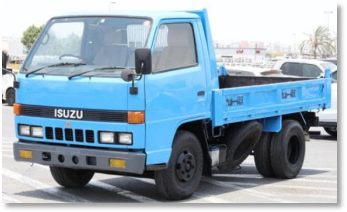
ELF is a brand name used by Isuzu Motors. “ELF” is an acronym that stands for “Excellent, Long-lasting, and Fuel-efficient.” Elf trucks are typically employed for small construction projects or when carrying materials to places with limited accessibility due to their versatility and agility. Cargo body dimensions (length x width x height) are approx; 2.4 x 1.79 x 0.38 meters. These trucks usually have a payload capacity of 2.5 to 3 tons. They are suitable for transporting materials like cement bags, sand, gravel, and smaller quantities of bricks or steel reinforcement. An Elf truck, for example, can transport around 1,000 bricks but would be prohibitively expensive for a residential project requiring 10,000 bricks.
FORWARD:
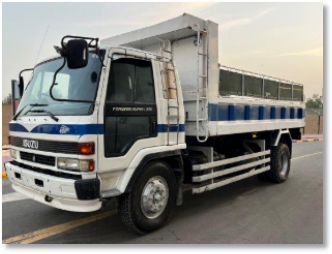
Forward trucks are widely used for medium-sized construction projects. Cargo body inside dimensions (length x width x height) are approx 4.0 x 2.16 x 0.45 m. They have a higher payload capacity than Elf trucks, ranging from 4.5 to 5 tons. These trucks can deliver a greater volume of goods, such as cement bags, aggregates, bricks, and steel reinforcement. A forward truck transports between 1800 and 2000 bricks (assuming a brick size of 100x100x200 mm). These are frequently utilized for low-budget clientele who want to get started with whatever money they have—locally known as “Ba Mukwata mpola.”
Other types of forward trucks are known as box-body or built-forward; the depth of the cabin is frequently expanded by welding additional plate to enhance capacity. This is because, according to the allowable axle configurations, a forward truck can carry up to 18 tonnes; thus, trucks are built to carry extra tonnage ranging from 10 to 12 tonnes.
MAGULUKUMI 10 & 12 (Japan):
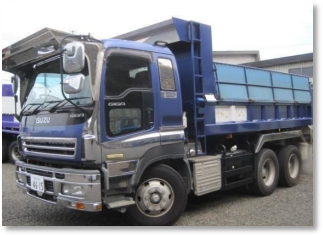
These are medium trucks that are typically used for construction projects that demand a large volume of building supplies. These trucks, with payload capacities ranging from 10 to 12 tons, deliver bigger quantities of goods, such as aggregates, bricks, steel reinforcement, roofing sheets, and timber. This truck transports approximately 3500-3700 bricks.
HOWO – SINOTRUKS
A Sinotruk dump truck (also known as a dumper/tipper truck) is a truck used to transport loose materials (such as sand, aggregate & murram) for construction. A conventional dump truck has an open-box bed that is hinged at the back and has hydraulic rams to elevate the front, allowing the material in the bed to be dropped (“dumped”) on the ground behind the truck at the delivery site. The payload capacity of Sinotruks might vary depending on factors such as truck configuration, axle configuration, and regional regulations.
SINOTRUK HOWO is a prominent dump truck model. SINOTRUK A7 & T7H 380 hp 10-wheelers, 30 tons, 20 cubic meters tipper; SINOTRUK HOWO 8X4 12-wheelers, 40 tons, 28 cm, 30 cm, 33 cm, & 36 cm dumpers. Locally, these are best classified as 10- and 12-tyre Sinotruks
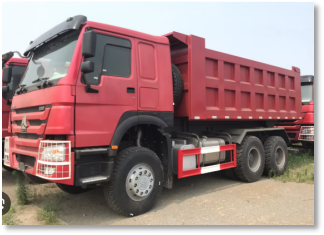
The Sinotruck 10-wheeler dump truck (6×4) is a popular type in Uganda, with dimensions (length x width x height) of 5.4 x 2.3 x 1.5-1.6 meters. It normally has a payload capacity ranging from 18 to 21m3 and a tonnage ranging from 28 to 35 tonnes, depending on the cargo being carried. This truck is ideal for hauling large quantities of building materials such as aggregates, sand, gravel, and crushed stone/stone dust.
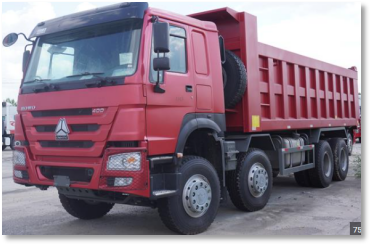
The Sinotruck Howo 12-wheeler dump truck (8×4) is a heavier-duty model with a greater payload capacity. Cargo body dimensions (length x width x height) are 6.8-7.8 x 2.3 x 1.5-1.6 meters. It typically has a payload capacity of 24- 26 m³ and a weight of 38-45 tons. This truck is suitable for transporting large quantities of construction materials over long distances, making it ideal for major infrastructure projects or hauling bulk materials such as aggregates and other heavy loads.
Many contractors may advise clients for residential projects to supply materials using such trucks as a cost-saving method. As for the bricks, a 12-wheeler Sinotruk carries around 10,000 bricks.
TIPPING DUMP TIPPER SEMI TRUCK TRAILERS (22 WHEELER)
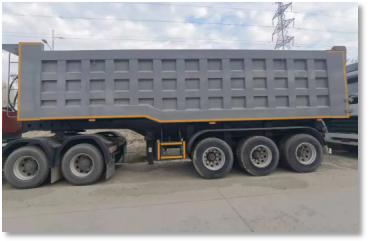
A tipping dump tipper semi-truck trailer, also known as a dump trailer or tipper trailer, is a type of semi-truck trailer built for hauling and unloading huge quantities of materials, such as reinforcement bars, cement, and tiles, in big quantities over long distances.
A tipping dump trailer with 22 wheels is typically composed of a trailer bed or body mounted on a chassis with multiple axles. The axle layout varies, but it typically contains a combination of tandem axles on the trailer and additional axles on the tractor unit to distribute weight. Their volume is around 30m3.
SPECIALIZED TRUCKS
In addition to the aforementioned truck types, specialized vehicles are utilized for specific construction materials. Cement tankers, for example, are used for the bulk transportation of cement in powder or liquid form, whereas flatbed trucks with cranes are utilized for the delivery of heavy and enormous products such as precast concrete panels or machinery.
Value for money
To deliver Lakesand from Lwera to Kampala & surrounding suburbs, a 12-wheeler Sinotruk (42 tonnes) will cost approximately UGX 1,900,000, which is equivalent to approximately 9 Forwards (4.5 tonnes), each costing UGX 300,000, for a total cost of approximately UGX 2,700,000, not including the time lost in the nine trips when using a Forward. This case study shows that employing Sinotruks provides the best value for money. There is a well-known local phrase that goes, “Owa kalina tagula forward.”
Conclusion
Understanding the capacity of different trucks used to deliver building materials is essential for effective logistics management in construction projects across Uganda.
Each truck type has a distinct payload capacity to accommodate different project sizes and material requirements. Clients and professionals in the construction industry can optimize their logistical operations, minimize costs, and ensure timely delivery of building materials to project sites by considering the appropriate truck capacity based on the payload capacity, volume, and type of materials to be transported.
By Antony Ainobushoborozi—Registered Quantity Surveyor (RSU Reg. No. 425, MISU No. 637


 No products in the cart.
Thanks for the good information